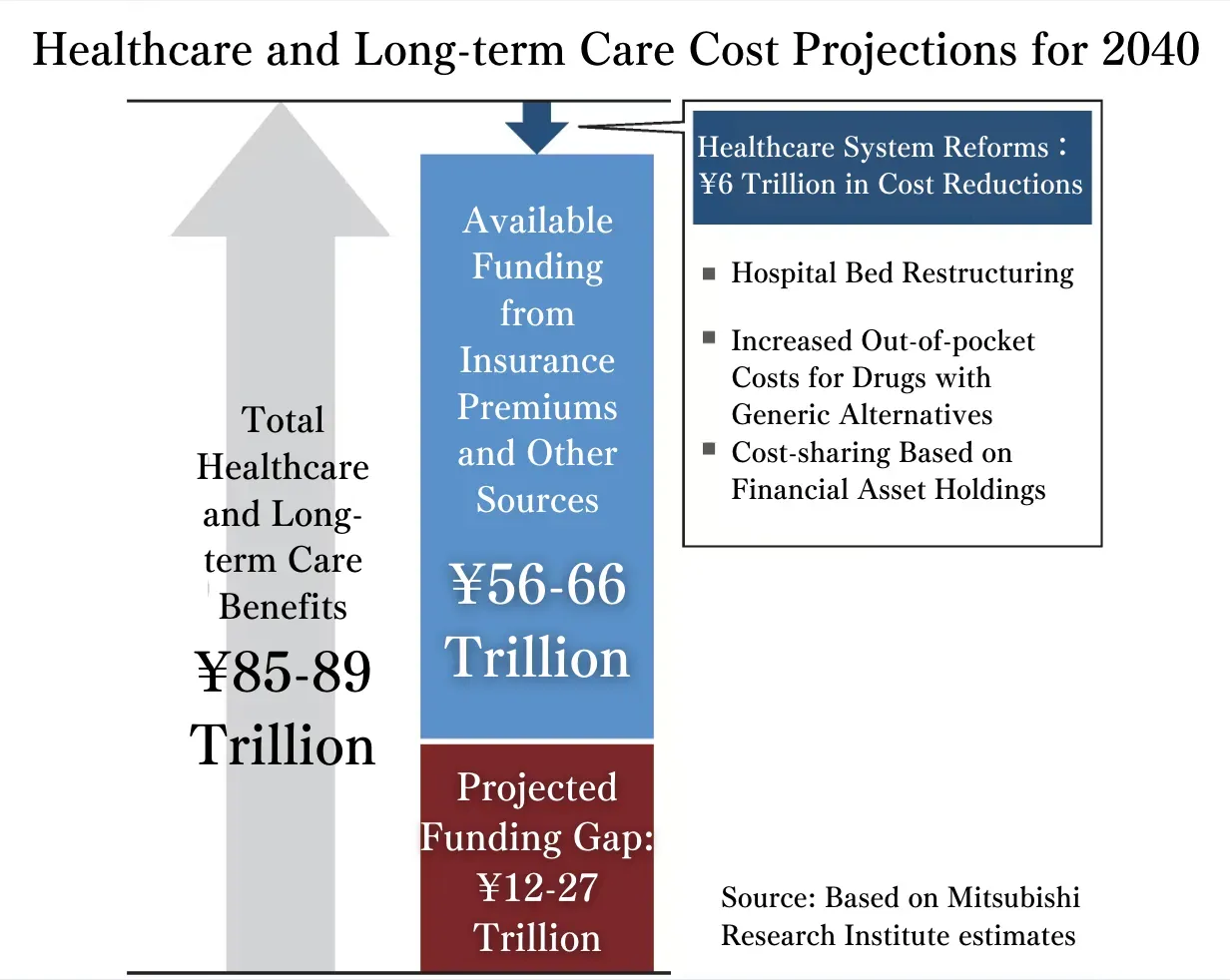
According to a January 22, 2024 Nikkei report, Japan’s healthcare and long-term care expenditure is projected to increase significantly. Private sector estimates indicate that by 2040, medical and long-term care benefits could surge by up to 60% from 2023 levels, reaching ¥89 trillion.
Funding Shortfall of ¥27 Trillion by 2040; Working Population Could Face Additional ¥460,000 Annual Burden
Based on 2018 insurance premium and public funding levels, only ¥56-66 trillion of the projected ¥89 trillion can be covered through existing taxation and insurance frameworks. Even assuming healthcare system reforms generate over ¥6 trillion in savings, a funding gap of ¥12-27 trillion remains. If this maximum shortfall of ¥27 trillion were to be funded entirely through insurance premiums rather than government bonds, the working-age population (20-65 years) would face an additional burden of approximately ¥460,000 per capita annually.
Generation Under 40 Bears the Burden; Insurance Premiums Fund 50% of Healthcare Costs
The projections assume hospital bed optimization and increased out-of-pocket payments for elderly patients. However, anticipated resistance from healthcare providers and the elderly population creates uncertainty around implementation timeline and effectiveness. As social security expenditure rises due to demographic aging, the burden disproportionately affects those currently under 40. With insurance premiums accounting for 50% of healthcare funding and premiums being income-linked, the working population faces an increasingly heavy financial burden.
Long-term Care Cost-sharing Increase Postponed Three Times; Addressing Inequity Essential
Addressing intergenerational disparities has become crucial. The government’s initiative to increase the proportion of elderly citizens paying 20% of long-term care costs was postponed for the third time in late 2023 due to resistance from the ruling coalition and service providers. While reduced benefits and tax increases may be necessary due to rising government expenditure, discussions regarding FY2024 budget and tax reforms remain insufficient. Experts suggest that “while considering the limitations of the working generation’s burden, tax increases should be evaluated to supplement public funding shortfalls.”
Expansion of 30% Healthcare Cost-sharing “Under Consideration Through FY2028”: Health Minister
Health Minister Keizo Takemi stated at a post-cabinet meeting press conference on the 17th that the expansion of 30% cost-sharing for those aged 75 and above, as outlined in the government’s Basic Policy on Aging Society approved on the 13th, “remains under consideration through FY2028.”
Minister Takemi emphasized that “considerations will account for potential impacts while ensuring necessary coverage is maintained.”
The government’s social security reform roadmap, released in late 2023, also indicated plans to review the expansion by FY2028. Takemi confirmed that the Basic Policy on Aging Society aligns with this timeline.
Currently, individuals aged 75 and above typically pay 10% of their healthcare costs, with those meeting certain income thresholds paying 20%, and those with “active worker-equivalent” income paying 30%. The “active worker-equivalent” threshold is currently set at annual income of approximately ¥3.83 million for single households. The review will focus on adjusting these income thresholds.
This comprehensive overview of Japan’s healthcare funding challenges highlights significant implications for the country’s fiscal sustainability and social security framework, factors that may influence investment considerations in the Japanese market.