Leveraging Home Care Nursing Stations as Consultation Hubs for Home Medical Care
Home care nursing stations serve as vital support for elderly individuals who wish to spend their final days at home. However, while these facilities are often perceived as services exclusively for critically ill patients, few utilize them in early stages. Home care nursing plays a crucial role in bridging medical and long-term care services, functioning as an accessible consultation hub for elderly individuals receiving home care and their supporting families.
“We won’t accept any more emergency transport requests! Living alone is not feasible!” An emergency physician raised his voice in a Tokyo hospital examination room. A woman in her late 80s, who had been transported by ambulance from her home in the early hours, sat in her wheelchair with a bewildered expression. Her nephew in his 50s, who rushed to the hospital after receiving their call, could only apologize.
The woman had called an ambulance just days before, citing feeling unwell in the early hours. She had also been transported approximately one month prior. Although examinations revealed no abnormalities, her limited mobility prevented independent return home, resulting in her nephew being summoned early each morning.
There has been a significant surge in elderly patients requiring emergency transport despite not needing urgent medical intervention. According to Ministry of Health, Labour and Welfare analysis of Fire and Disaster Management Agency data, approximately 756,000 elderly individuals transported by emergency services in 2020 showed unclear symptoms or no diagnosis at examination—a 60% increase (approximately 290,000 cases) from a decade ago.
Emergency transport of elderly patients reached approximately 3.3 million cases in 2020, increasing by about 761,000 over the previous decade. Nearly 40% of this increase comprised patients with unclear symptoms. While respiratory and cardiac conditions showed modest increases of 30,000-40,000 cases, emergency transport of children and adults under 65 decreased. Non-critical elderly cases have become a significant factor in emergency medical service congestion.
In the aforementioned case, the nephew consulted a care manager who referred him to a clinic specializing in home medical care. The clinic became her primary care provider for hypertension and mild dementia. Under the physician’s direction, nurses from an affiliated home care nursing station began visiting once or twice monthly, establishing a system for emergency response.
It took eight months before the nephew no longer needed to take time off work to respond to emergencies. He noted, “We should have utilized 24-hour home care nursing services much earlier.”
Care managers typically prioritize creating care plans centered on helpers under long-term care insurance, often relegating physician-directed home care nursing to secondary consideration. Physicians at clinics cannot issue home care nursing directives under long-term care insurance for patients previously treated under medical insurance unless they personally provide home medical care.
Home care nursing stations serve as the bridge between these two complex insurance systems. Early implementation of physician-directed home care nursing for elderly individuals with limited mobility enables flexible emergency response utilizing both medical and long-term care insurance.
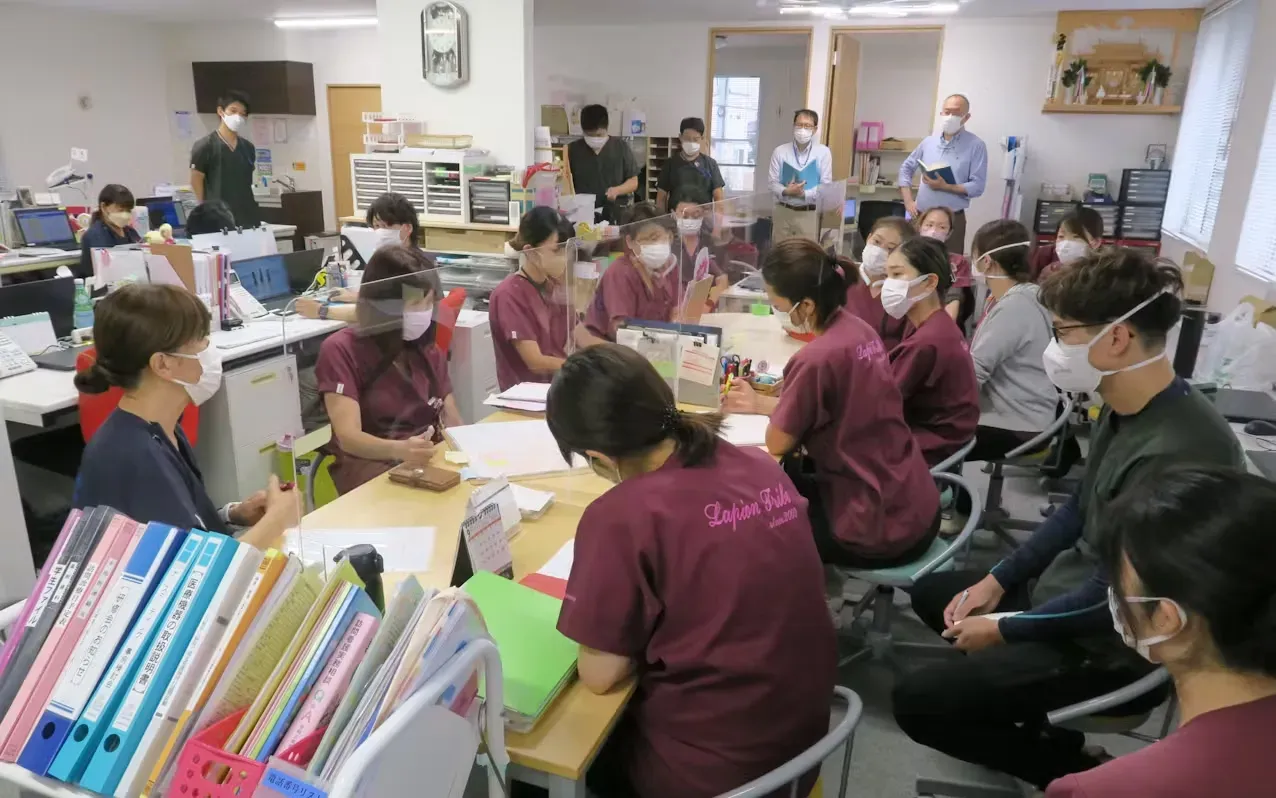
Rapione Nurse Station in Hino City, Tokyo, operates 24/7, providing consultation services for elderly individuals and their families. They coordinate with local medical institutions and community support centers for emergency response.
The number of home care nursing stations nationwide has exceeded 15,000. Minako Shibata, a nurse and representative of Rapione, recommends “enhanced function” home care nursing stations as primary consultation resources. These facilities maintain higher full-time nursing staff levels, accumulated end-of-life care experience, established consultation systems, and increased placement of specialized nurses.
Shibata advises, “Those seeking home medical care should first consult their primary care physician or care manager. If unable to receive adequate support, consider consulting nearby enhanced function facilities.”
While enhanced function facilities are increasing, they currently number just over 800 nationwide. If none are readily accessible, consulting home care nursing stations advertising “24-hour response” on their websites presents an alternative option.
Increase in Home Deaths During COVID-19 Pandemic
The COVID-19 pandemic has led to a significant increase in the number of people passing away at home. According to the Ministry of Health, Labour and Welfare’s vital statistics, approximately 273,000 people died at home in 2022, representing 17% of total deaths. This figure shows an increase of about 85,000 compared to pre-pandemic levels in 2019, with the proportion of home deaths rising by nearly 4 percentage points over three years, breaking from its previously stable trend.
While hospitals remain the primary location of death with 1.011 million cases (64% of total deaths), this represents only a modest increase of 26,000 cases compared to 2019, with the proportion declining by 7 percentage points. This shift suggests that more people are choosing to spend their final moments at home rather than in hospitals where infection control measures restricted family visitation.
A survey by the Nippon Foundation indicates that nearly 60% of respondents wish to spend their final days at home. However, 95% of the parent generation expresses concern about becoming a burden on their families, highlighting the critical need for enhanced home care support systems.