Key Points:
- Consumer spending stagnation reflects household behavior compensating for pension system vulnerability
- Extension of basic pension contributions needed, predicated on elderly employment
- Addressing health disparities crucial for sustainable elderly employment
Household consumption in Japan continues to show persistent weakness. According to the Family Income and Expenditure Survey, real monthly consumption expenditure per household (two or more persons) has been on a downward trend since its peak of ¥354,581 in 1992, declining to ¥278,406 in 2023 (nominal values from annual household survey reports adjusted for inflation using 2020-base CPI).
This analysis explores the root causes of sluggish personal consumption and proposes measures to achieve sustainable consumption patterns.
When households face increased environmental uncertainty, they typically reduce consumption expenditure and increase precautionary savings. Japan’s economy has encountered various events that have elevated household uncertainty, including the Great Hanshin Earthquake, the Great East Japan Earthquake, and the COVID-19 pandemic.
The 2008 Global Financial Crisis represented an economic shock that heightened uncertainty on a global scale. While these events were largely unpredictable negative shocks that increased household uncertainty and had adverse impacts, not all uncertainty-inducing events are unpredictable.
Japan’s aging demographic trend serves as a prime example of a foreseeable challenge that has led to increased uncertainty due to inadequate policy responses. The progression of aging is a structural phenomenon inherent to Japan’s economy, with demographic projections making its trajectory relatively predictable. The government has implemented measures to address aging, primarily through the design of the public pension system.
If the public pension system design were robust and commanded complete household confidence, the impact on household behavior would be minimal. However, when households perceive vulnerabilities in the public pension system, they tend to reduce consumption and increase precautionary savings to complement pension benefits for a secure retirement. The observed trend of declining consumption levels in Japan can be interpreted as household behavior compensating for perceived vulnerabilities in the public pension system.
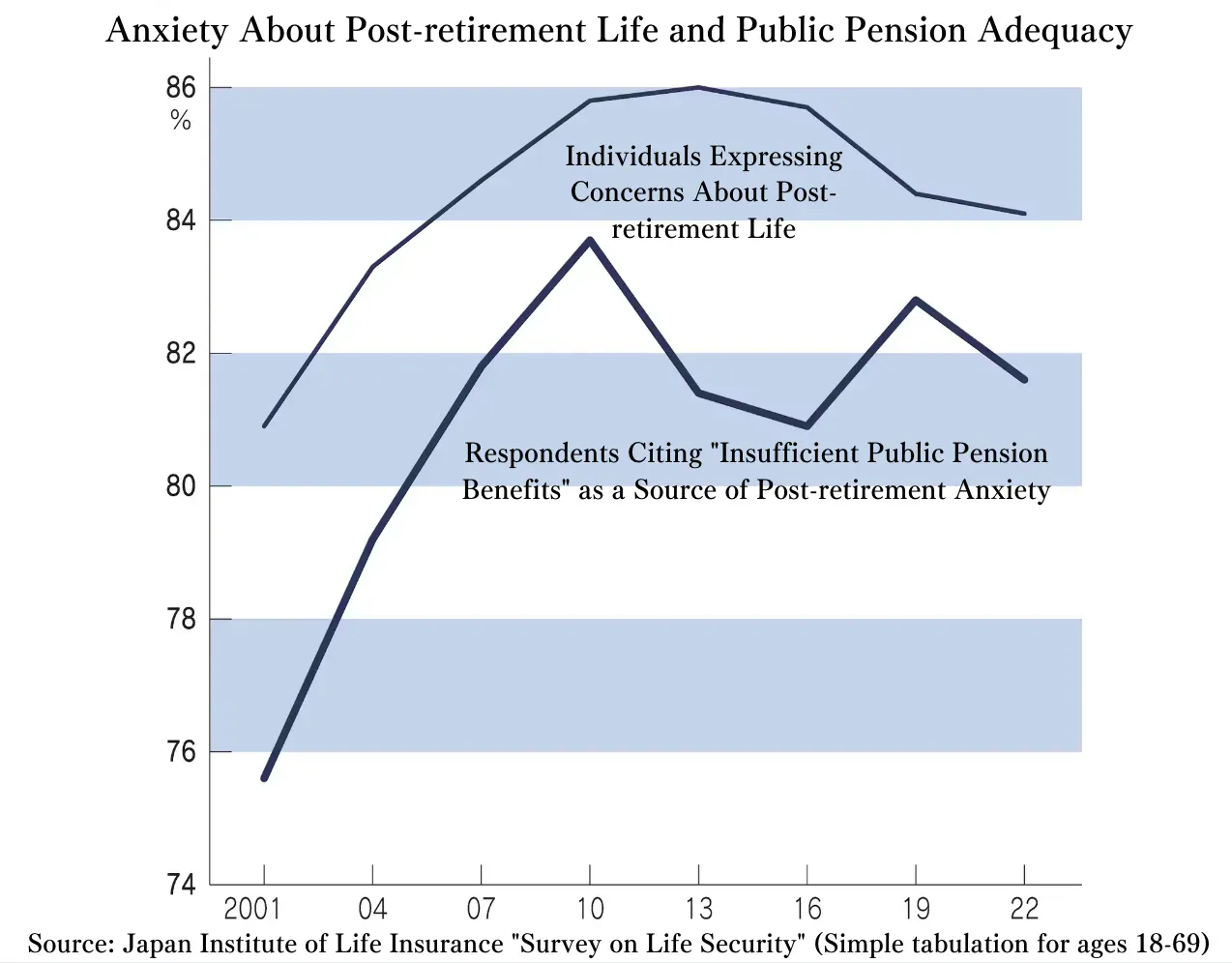
To understand how households view retirement planning and evaluate the public pension system, let’s examine time-series data (2001-2022) from the Japan Institute of Life Insurance’s “Survey on Life Security” (See Figure).
Over 80% of individuals consistently express concerns about post-retirement life. The primary reason cited is “insufficient public pension benefits,” with around 80% of individuals considering public pension alone inadequate. Similarly, nearly 80% disagree with the statement that “public pension can cover a substantial portion of daily living expenses in retirement.” The majority of households negatively evaluate the public pension system, considering benefit levels insufficient for maintaining stable post-retirement living standards.
According to the “Public Opinion Survey on Life Planning and Pensions” conducted in 2023, 44.4% of individuals indicate they will “continue working while adjusting working hours to maintain pension amounts” upon reaching the employees’ pension eligibility age. An additional 14.0% plan to “continue working regardless of pension amount impacts.” Employment plays a crucial role in maintaining living standards for elderly households.
75.2% of individuals cite “earning a living” as their reason for wanting to work beyond age 60 (multiple responses allowed). Due to insufficient pension benefits, many elderly individuals continue working to maintain their lifestyle.
While economic theory traditionally views labor supply as an income-generating mechanism with negative utility, 36.9% of individuals cite “purpose in life and social participation” as their motivation for working beyond 60, indicating positive utility from labor supply among the elderly.
This positive utility from work is corroborated by other research. The Panel Data Research Center at Keio University conducts annual Japanese Household Panel Surveys (JHPS/KHPS) covering employment, consumption, income, education, health/medical care, and housing. The author’s econometric analysis of happiness determinants using 2011-2021 panel data reveals significantly increased happiness levels among households who “wish to continue working at the same company as last year.”
Elderly labor participation contributes to public pension system stability and reduces future uncertainty for households. The Ministry of Health, Labour and Welfare conducts periodic fiscal verifications of the national and employees’ pension systems at least every five years. The 2024 fiscal verification projects future income replacement rates (ratio of pension benefits to average working-age male take-home pay) under various scenarios.
Extending the basic pension contribution period from the current 40 years (ages 20-59) to 45 years (ages 20-64) would increase the income replacement rate from 50.4% to 57.3%, assuming economic conditions of the past 30 years continue. This increase would benefit all insured persons through enhanced basic pension benefits. While the government plans to defer this proposal due to increased economic burden on those over 60, the burden would be significantly offset by income gains from continued employment.
Furthermore, abolishing the pension reduction system for working pensioners could encourage increased elderly employment. While this would decrease the earnings-related portion’s replacement rate due to increased employees’ pension benefits, the basic pension would remain unaffected.
Continued elderly employment would secure stable income through both labor earnings and pension benefits. Extended basic pension contribution periods would enhance basic pension benefits for all insured persons and address system vulnerabilities. This reduction in household uncertainty could stimulate consumption through decreased precautionary savings.
Finally, maintaining health is essential for sustainable elderly employment. Health disparities exist among elderly populations based on income levels. Elderly individuals needing to work to supplement pension benefits typically have lower incomes and face greater health risks. Establishing inclusive social networks and implementing health improvement programs (sports organizations, hobby groups, volunteer groups) to maintain elderly health is an urgent priority.