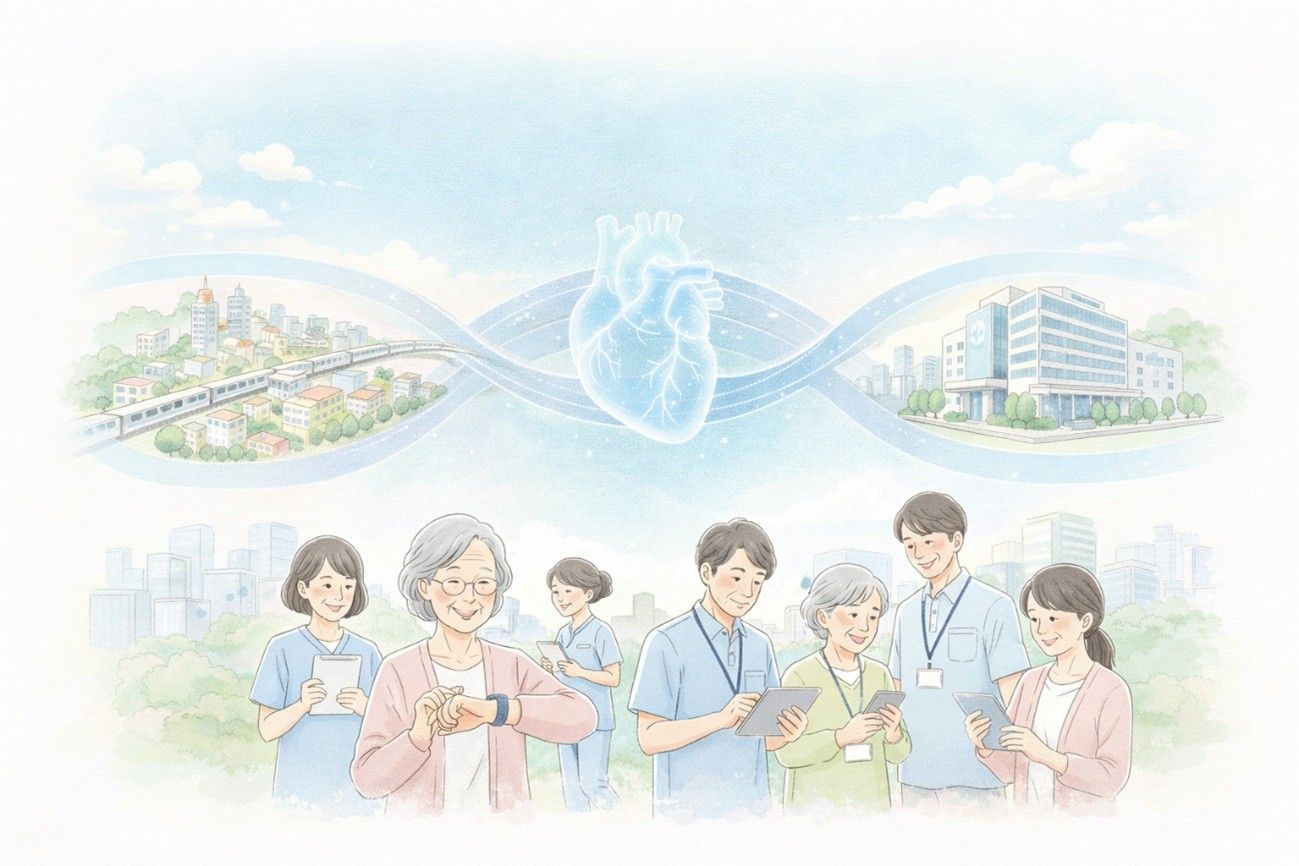
Hankyu Hanshin Holdings, Hitachi, and the Osaka University Graduate School have begun joint discussions on a “home-based heart failure self-management support service” utilizing digital technology. By integrating health data aggregated into a PHR (Personal Health Record) application with real-world lifestyle services, the initiative aims to promote patient self-management and behavioral change, and to build a sustainable healthcare model that prevents disease exacerbation and hospital readmissions.
A distinctive feature of this initiative is the participation of Hankyu Hanshin Holdings, a company that operates lifestyle infrastructure such as railways and real estate, rather than limiting the effort to a simple health-monitoring application. In addition to improving the quality of life (QOL) of patients and caregivers, the project aims to facilitate digital information-sharing among medical and caregiving professionals and support operational efficiency.
NPMI views initiatives like this—where the primary providers of healthcare are expanding beyond hospitals to include diverse service operators—as requiring a bridging role that connects medical expertise with business design. In particular, as healthcare-related services involving for-profit entities expand, there is a high risk that projects may be designed without sufficient understanding of clinical realities or institutional frameworks, leading to mismatches with both patients and healthcare professionals. Leveraging domain-specific knowledge in healthcare and long-term care, NPMI will be responsible for structural design that balances practical implementation in clinical settings with business viability, engaging not merely as a capital provider but as a hands-on partner. By participating in projects as experts who understand frontline challenges, NPMI seeks to minimize friction during the transition of healthcare infrastructure toward new stakeholders and support the establishment of sustainable service models.
References
【Glossary: Industry–Academia Collaboration】
Industry–academia collaboration refers to cooperative frameworks between universities and research institutions (academia), which conduct research and development of new technologies, and private companies (industry), which commercialize and implement these outcomes. By integrating the “technology seeds” held by universities with the “market needs” and “implementation capabilities” of companies, the goal is to generate innovative breakthroughs that cannot be achieved independently.
As seen in the case of the “home-based heart failure self-management support service,” particularly in fields that integrate advanced medical knowledge with everyday lifestyle infrastructure, such collaboration is indispensable for connecting academic evidence with business models at a high level. This creates mechanisms through which research outcomes can be directly translated into solutions for real societal challenges.
At the same time, numerous barriers exist in moving beyond mere “joint research” and ensuring that industry–academia collaboration takes root as a sustainable business. These include the specialized expertise required to translate academic findings into business contexts, long-term support for commercialization, and coordination functions that reconcile the differing logics of industry, academia, and government. In life-critical fields such as healthcare and long-term care, the presence of strategic partners grounded in domain knowledge—capable of maintaining reliable evidence while driving rapid social implementation—is a decisive factor in project success.
References