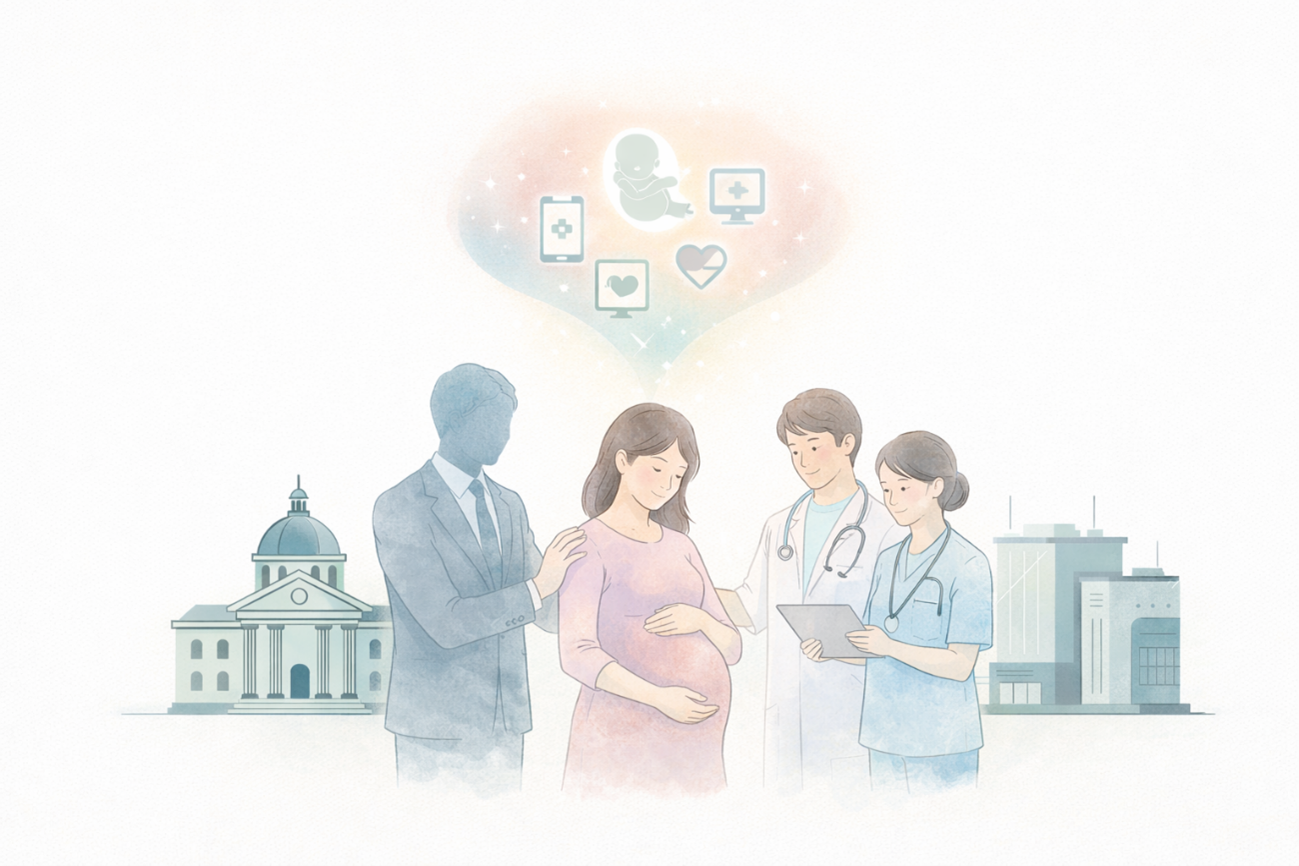
The Children and Families Agency has decided on a policy to establish a nationwide “standard amount” to achieve zero out-of-pocket costs for prenatal checkups. Currently, public subsidies and consultation fees vary by municipality and medical institution, creating regional disparities of more than 50,000 yen in some cases. The government plans to submit an amendment to the Maternal and Child Health Act to the ordinary Diet session in 2026, aiming to accelerate countermeasures against declining birthrates by removing financial barriers.
Prenatal checkups are not covered by public health insurance, and medical institutions are free to set prices; as a result, approximately 65% of facilities nationwide require patient out-of-pocket payments. Under the new system, the government will present a standard fee based on medical service reimbursement levels and impose a best-effort obligation on medical institutions and municipalities to comply. In addition, the “Shussan Navi” search site will be used to visualize costs, enabling pregnant women to make informed choices regarding self-paid examinations outside the standard framework.
NPMI evaluates the standardization of costs as a transformative turning point that goes beyond simply reducing financial burden and instead removes the “barrier to commercialization” within the perinatal healthcare industry. As market pricing—previously opaque due to the nature of private practice—becomes structured, advanced diagnostic technologies and digital health services can be appropriately valued and more widely adopted. In response to this institutional shift, NPMI will take on a role in translating advanced technologies such as fetal diagnostics and remote care into sustainable business models that are feasible for implementation in clinical settings. Drawing on specialized domain knowledge, NPMI will bridge institutional frameworks and clinical practice, and strongly support the development of next-generation maternal and child health infrastructure from both capital and management perspectives.
References
【Glossary: Prenatal Checkups】
Prenatal checkups (prenatal health examinations) refer to regular medical consultations conducted during pregnancy to confirm the health status of both the mother and fetus and to enable early detection and response to potential medical conditions. Typically, around 14 visits are recommended before childbirth, including blood glucose and blood pressure measurements, ultrasound monitoring of fetal growth, and mental health support for the mother—making them a critical point of medical contact for ensuring maternal and fetal safety.
A major institutional characteristic is that prenatal checkups are categorized as private medical services not covered by public health insurance, as they are not treatments for illness. Consequently, patients’ out-of-pocket costs depend heavily on municipal subsidy systems, and regional economic disparities have long been a persistent issue amid ongoing efforts to address declining birthrates.
Going forward, as the national government advances cost standardization and digitalization (including linkage with PHR systems), prenatal checkups are expected to evolve from mere “testing” into “continuous perinatal care” that utilizes accumulated data. However, during such a major institutional transition, administrative support alone is insufficient to introduce new technologies smoothly while reducing the burden on medical settings. The presence of specialized partners—capable of connecting frontline needs with innovative solutions and accelerating commercialization based on deep healthcare domain insight—as well as forward-looking capital support, will be key to building next-generation maternal and child health infrastructure.
References