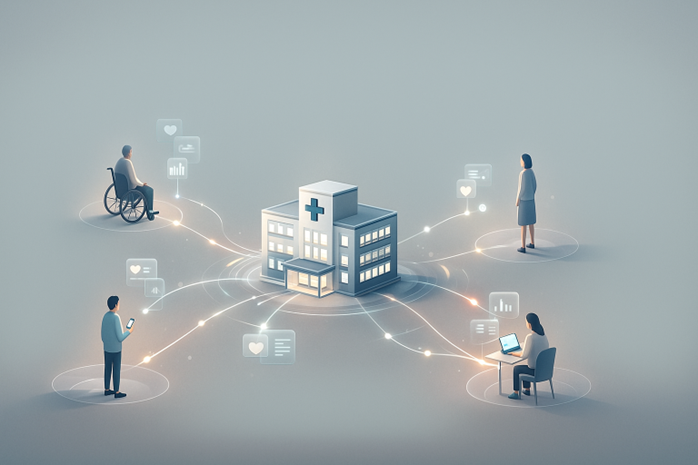
In Hachimantai City, Iwate Prefecture, a practical model of regional healthcare digital transformation (DX) is taking shape through close collaboration among the public sector, industry, and academia. Over a five-year pilot period, the city has developed and validated a system that integrates telemedicine with home-visit nursing, enabling nurses to visit patients’ homes while physicians provide real-time medical supervision remotely.
This model has proven particularly effective in Hachimantai, a heavy-snowfall region where access to outpatient care is often constrained. By combining in-person assessments conducted by visiting nurses—such as vital signs monitoring and physical examinations—with physicians’ remote clinical decision-making, the system preserves quality of care while improving operational efficiency. Importantly, it offers a viable solution for regions facing an uneven distribution of physicians, a structural challenge increasingly common in rural Japan.
The pilot is operated by the Hachimantai Meditech Valley Consortium, which has taken a region-wide approach to healthcare reform. Its initiatives extend beyond telemedicine to include joint procurement of pharmaceuticals, the development of shared medical data infrastructure, and the modernization of professional training frameworks. Local government authorities have explicitly positioned this effort as an attempt to “define the future standard for home-visit nursing,” emphasizing regulatory alignment for online medical services and continued investment in digital infrastructure.
Looking ahead, a key question is how healthcare coordination—now increasingly standard in urban settings—can be effectively replicated in geographically constrained regions and translated into a sustainable, long-term healthcare delivery system.
NPMI Perspective
From NPMI’s standpoint, Hachimantai City’s initiative represents a compelling example of healthcare DX that pragmatically reconfigures care delivery in physician-scarce regions. The integration of home-visit nursing with telemedicine is particularly noteworthy as a mechanism for maintaining clinical quality under constrained medical resources. As such, this model holds significant potential for broader national deployment and could serve as a foundational blueprint for enhancing the sustainability of regional healthcare systems across Japan.
References
【Key Term: Nurse-Accompanied Online Medical Care】
Nurse-accompanied online medical care refers to a telemedicine model in which a visiting nurse attends the patient in person at their home, while a physician conducts the consultation remotely via ICT tools. The nurse is responsible for collecting vital signs, observing physical conditions, and supporting the medical interview, enabling the physician to make informed clinical judgments in real time.
This model is particularly effective in remote, depopulated, or heavy-snowfall regions where patient mobility is limited. Compared with standard outpatient-style telemedicine, the presence of a nurse allows for more accurate patient assessment and makes the model well suited for elderly care and patients with higher risks of acute deterioration. Because it relies on robust digital infrastructure and an established home-visit nursing framework, successful scaling depends on coordinated efforts among local governments, healthcare providers, and IT vendors.
References