On the 17th, Sony Honda Mobility, a joint venture equally financed by Sony Group and Honda, unveiled a prototype of its electric vehicle (EV) named “AFEELA” for the first time in Japan. The company is not solely focusing on the sales of the vehicle itself but also aims to derive recurring revenue from in-car entertainment such as movies, music, and games through subscription services. In an era where automobiles are increasingly becoming akin to smartphones, constantly connected to cloud services, the ability to continuously provide new value and services through software updates has become a critical competitive edge.
At a press conference on the 17th, Izumi Kawanishi, the president of Sony Honda, laid out plans to make the development environment for mobility more open, allowing external businesses to easily develop applications and software that run on AFEELA. Users, much like with smartphone apps, will be able to download and utilize a variety of functions such as video, music, and mapping information directly through the car’s screen.
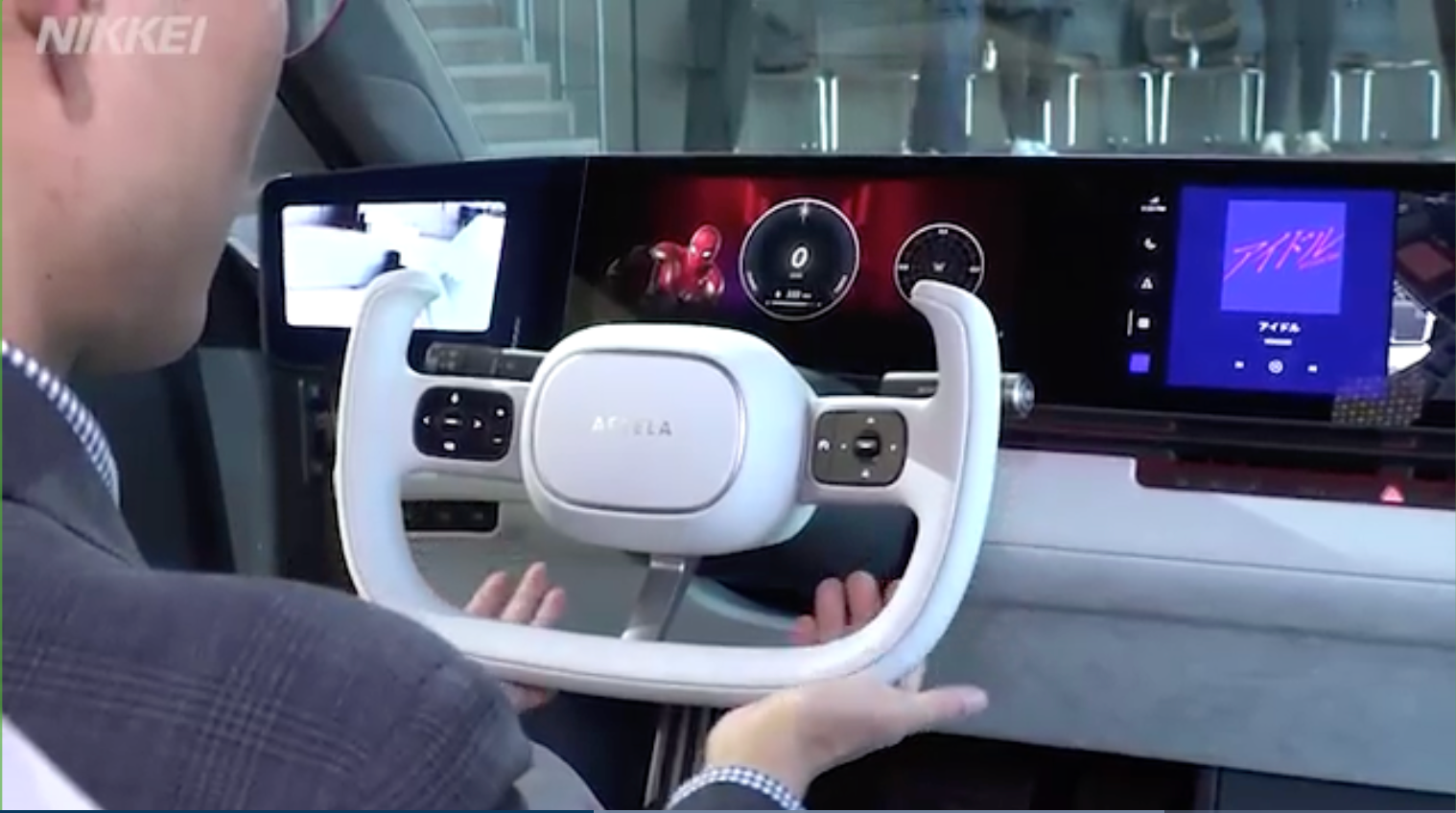
Journalists had a “hands-on” experience with AFEELA on the 16th, where they were first taken aback by the absence of conventional door handles. Instead, cameras located at the top of the doors recognized faces, prompting the doors to open automatically. A widescreen touch panel stretched across the front of the driver’s seat, offering an array of entertainment options.
During the ride, the popular unit from Sony’s music label, YOASOBI, played their track “Idol,” delivering a live concert-like experience with its rich sound. The vehicle even allows for the motor’s acceleration sound to be replaced with sound effects matching the ambiance of a favorite movie. Furthermore, by connecting Sony’s game controllers, passengers can enjoy gaming, transforming the journey into an entertainment experience.
What makes such a remarkable riding experience possible are the smartphone-surpassing features packed into AFEELA. It uses Qualcomm’s Snapdragon, known for powering smartphones, as its brain, connects to cloud services via 5G for high-speed wireless communication, and constantly offers the latest movies, music, and games on its own operating system.
The driver’s seat of Sony Honda Mobility’s electric vehicle (EV) prototype “AFEELA”
AFEELA is scheduled to begin accepting orders online in 2025, and the development is in its final stages. Production will take place at Honda’s North American factory, with deliveries starting in North America in the spring of 2026, followed by Japan in the latter half of the year.
Sony Honda Mobility aims for a “recurring” business model, earning continuous subscription income, not just from vehicle sales. The company is considering various services, including purchasing movies and games via the vehicle’s display or subscribing to driver assistance features.
Sony Group, leveraging its experience with the PlayStation’s subscription services, is venturing into the mobility sector. President Kawanishi of Sony Honda predicts that while hardware will initially hold significant value, additional services and software will increasingly contribute to revenue.
| France: Renault | Navigation apps and email reception through Google’s Android operating system. |
| Germany: Bosch | Collaboration with Croatian company Rimac for emergency insurance company information provision. |
| Sweden: Volvo | Offering movies and other content through Amazon.com’s Prime Video. |
| Germany: Mercedes-Benz | In-car video conferencing system in partnership with Cisco Systems. |
| USA: Tesla | Over-the-air updates for in-car camera malfunctions and recalls, as well as autonomous driving feature enhancements. |
Diversifying Revenue Through Software Innovation
The innovation of AFEELA goes beyond enjoying audio and visual content; the company is contemplating services that would allow software updates to refine driving functions. Global automotive giants are advancing the use of “Software-Defined Vehicles (SDV)” that keep vehicle features constantly updated. The competition lies in providing services that continue to generate income after the vehicle sale.
Tesla has led with its “Over-the-Air (OTA)” updates, resolving about 40% of recalls through this method. The system even allows for repairs to be made while the vehicle owner is away, addressing issues from rearview camera malfunctions to taillight defects.
The appeal of SDVs is set to significantly impact car manufacturers’ profitability. Boston Consulting Group (BCG) predicts that by 2030, SDVs will create over $650 billion in value for the auto industry, accounting for 15-20% of the global car market. Revenue from car software and electronics is expected to grow 2.9 times by 2030 from 2023, reaching $248 billion.
As the value of cars shifts towards software, partnerships within the industry are also evolving. French automaker Renault has teamed up with Google for in-car software development in 2022, while Volvo from Sweden announced a service with Amazon.com to enjoy the video streaming service “Prime Video” in their cars.
In the past year, the rise of Chinese players in the EV market has been significant. In 2022, China’s EV sales increased by 82% from the previous year, totaling 5.36 million units, surpassing the total new car sales in Japan. BYD from China topped the global EV sales, overtaking Tesla.
Within the major trends of SDVs and EVs, the shift away from the traditional “sell-and-done” hardware model is a common challenge in the auto industry. Honda, in collaboration with Mitsubishi Corporation, is considering a system that would allow the sale of stored electricity from batteries starting in 2026. By combining multiple EVs, they could be treated as a giant battery system, potentially stabilizing Japan’s power supply and demand balance.
At this pivotal moment of industry transformation, whether traditional car business models can pivot to build new revenue streams remains to be seen. The challenge taken on by Sony Honda Mobility may well be a litmus test for the future.
(Keiichi Furukawa, Shoya Okinaga, Yumi Okura)