We—Nihon PMI Partners, Japan’s leading sector-specialized healthcare buyout fund—support companies alongside healthcare experts, including MDs.
Currently, over 90% of hospitals in the US and the UK have adopted Electronic Medical Records (EMRs), establishing medical DX (Digital Transformation) as a standard infrastructure. Meanwhile, the adoption rate among general hospitals in Japan remains at around 65%, lagging significantly behind global standards.
Although the Japanese government is promoting this as a national strategy, structural barriers such as high costs, fragmented IT environments across hospitals, and a shortage of DX personnel stand in the way of actual implementation.
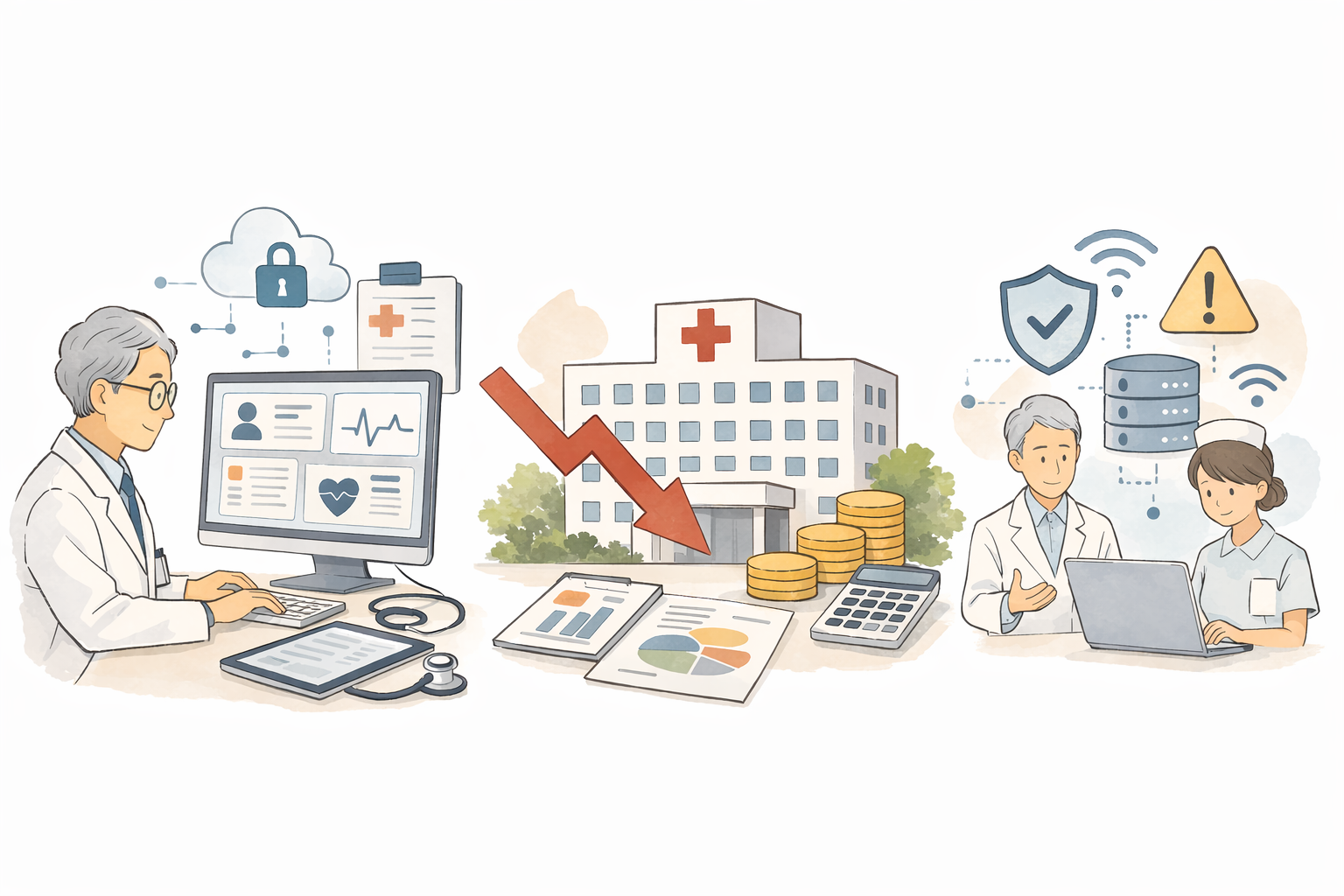
Specifically, there are three major challenges currently facing the Japanese medical frontline:
Paper charts have been the standard for years, and the frontline isn’t struggling.
- In local private clinics, the use of paper charts is deeply rooted. Because the number of patients and staff accessing the records is limited, they can often “get by just fine with paper.” As a result, the burden of changing familiar workflows outweighs the benefits of digitization, causing implementation to be postponed.
Over 60% of hospitals are operating at a deficit.
- Approximately 60.9% of hospitals in Japan are running an ordinary deficit. They lack the financial capacity to cover initial implementation and ongoing maintenance costs. Even if they understand the necessity, an increasing number of hospitals find themselves in a situation where they “want to implement EMRs but simply cannot afford to.”
The compounding factors of Risk, People, and the System.
Risk (Disasters): In disaster-prone Japan, which frequently experiences earthquakes and typhoons, the risk of power outages or network failures making patient data inaccessible—which effectively halts medical care—is a severe, life-threatening concern.
People (Learning Curve): For elderly doctors and staff unfamiliar with IT, learning a completely new system from scratch is highly stressful and adds a significant burden to their daily workload.
System (Not Mandatory): In Japan, although subsidies are available for the adoption of electronic medical records, there is no legal mandate requiring their use and no clear penalties for failing to adopt them. As a result, institutional incentives and enforcement mechanisms remain relatively weak. For example, in the United States, the HITECH Act (2009) promoted widespread adoption of electronic medical records by providing financial support for implementation while also imposing practical disadvantages on institutions that did not adopt them. In contrast, in Japan, since there are no immediate and significant disadvantages in terms of reimbursement for not introducing such systems, the decision is largely left to each medical institution. This has created a structure in which the pace of adoption tends to be slower.
Understanding this complex background, we are committed to supporting hospitals in navigating and advancing their digital transformation.