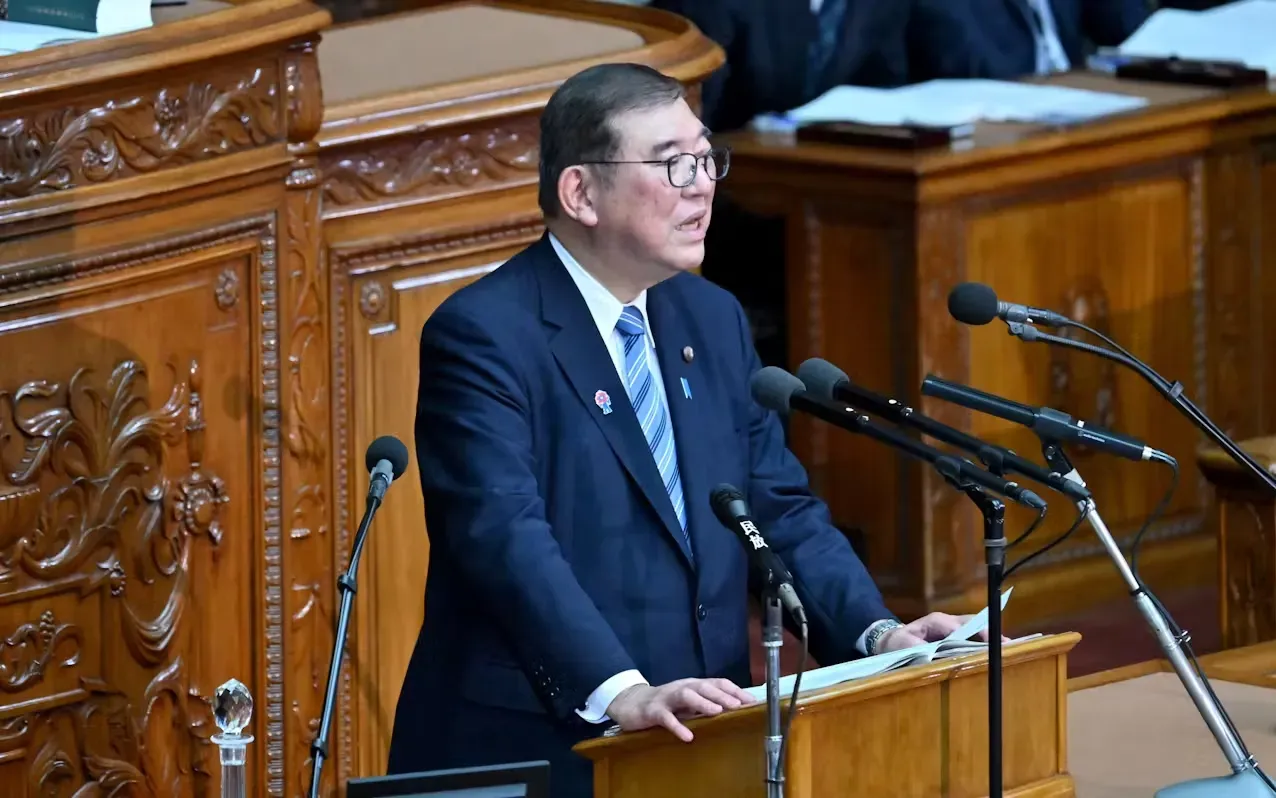
Prime Minister Shigeru Ishiba delivered his inaugural policy speech to both houses of the Diet on January 24, dedicating approximately one-third of his address to his flagship regional revitalization initiative. He presented five key pillars for achieving the “Reiwa Era Archipelago Transformation,” including infrastructure development focused on decarbonization and digitalization, while largely maintaining continuity in existing economic policies.
Noting that 2025 marks both the 80th anniversary of the post-war era and the 100th year of the Showa era, Ishiba positioned it as “a year to reflect on Japan’s journey and envision a new Japan.” He emphasized that “Regional Revitalization 2.0 is central to creating an ‘Enjoyable Japan,'” which he plans to advance as the Reiwa Era Archipelago Transformation.
The five pillars comprise:
- Making regional areas attractive to youth and women
- Facilitating regional relocation of government, private sector, and academic institutions
- Fostering regional innovation
- Developing new-era infrastructure
- Promoting cross-prefectural cooperation
To attract younger generations and women to regional areas, the administration will support dual-base lifestyles between urban and regional areas and introduce legislation to address gender wage disparities. Regarding institutional relocation, Ishiba stated that “government will take the initiative,” promoting the relocation of agencies such as the Disaster Prevention Agency and soliciting proposals from regional authorities.
The administration emphasizes infrastructure development supporting Green Transformation (GX) and Digital Transformation (DX), encouraging the redistribution of industrial and residential hubs. This includes efficient development of decarbonized power supply networks incorporating renewable energy and nuclear power.
Addressing demographic challenges, Ishiba acknowledged Japan’s stark reality: government projections indicate the working-age population (15-64) will decline from 75 million in 2020 to approximately 45 million by 2070, with total population falling below 90 million.
The administration’s vision differs from former Prime Minister Tanaka’s infrastructure-centric approach, emphasizing that “Regional Revitalization 2.0 generates population flow through both hard and soft attractions.” Ishiba stressed the importance of “creating sustainable regional infrastructure utilizing AI and digital technology,” citing examples such as autonomous driving systems, shared electronic medical records, and telemedicine infrastructure.
Regarding fiscal policy, the administration committed to presenting measures toward fiscal consolidation, including early achievement of a primary balance surplus, in this summer’s Basic Policy on Economic and Fiscal Management and Reform.
The speech maintained previous economic policies, including the target of raising the national average minimum wage to ¥1,500 in the 2020s, and reiterated the three-pronged labor market reform focusing on reskilling, job-based personnel systems, and labor mobility.
This comprehensive policy framework signals a significant shift toward addressing Japan’s demographic challenges through regional revitalization, digital transformation, and infrastructure development, while maintaining fiscal discipline and economic reform initiatives.