A surge of high-profile visits by executives from global investment powerhouses to Japan is underway. These leaders are unanimously expressing keen interest in large-scale corporate acquisitions within the country. We’re witnessing an uptick in instances of companies going private through fund-backed delistings, such as Toshiba and Japan KFC Holdings. As this trend of fund-driven privatizations gains momentum, mirroring patterns seen in the U.S. and Europe, what implications does this hold for Japan’s financial markets?
Major Funds Poised for Substantial Acquisitions in Japan
“The returns on private equity investments in Japan have been nothing short of phenomenal. There’s still significant untapped potential,” remarked Harvey Schwartz, CEO of Carlyle Group, one of the U.S.’s leading private equity (PE) firms, during his visit to Japan in late May.
Coinciding with the CEO’s visit, Carlyle announced a tender offer for Japan KFC, the operator of “Kentucky Fried Chicken” in the country. Set to delist in September, Japan KFC will transition under the fund’s umbrella, potentially emerging as a key player in the restructuring of the food service industry. Global PE giants such as Blackstone and KKR are all making strategic moves to capitalize on the weak yen, injecting unprecedented levels of acquisition capital into Japan’s industrial landscape.
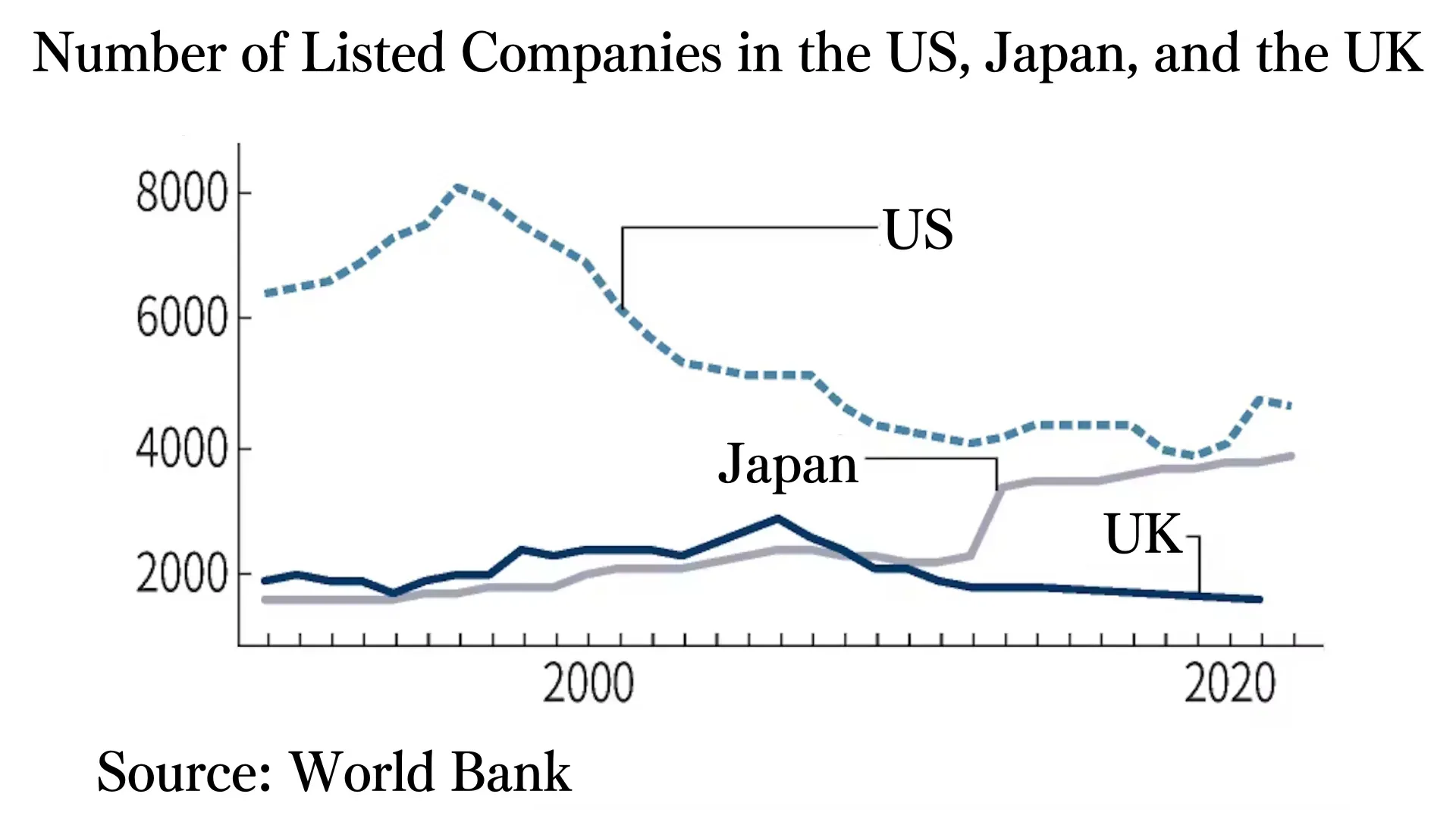
The United States has seen a wave of PE-driven large-scale corporate acquisitions since the 1980s, establishing a trend of taking investment targets private for restructuring. This fund-led industrial reorganization has halved the number of listed companies in the U.S. over the past quarter-century from its 1996 peak. The UK and Germany have also experienced a 40% reduction in listed entities from their respective peaks. Japan’s continual increase in public companies now stands as an anomaly among major economies.
The Dawn of a Private Equity Era in Japan?
With the current buyout frenzy by investment funds, is Japan on the cusp of a private equity revolution? The country is already experiencing a surge in Management Buyouts (MBOs) fueled by fund capital. In FY2023, 18 companies announced MBOs, with the total stock acquisition value reaching a record high of 1.4688 trillion yen, a fivefold increase from the previous fiscal year. This momentum shows no signs of abating in FY2024, with major players like Japan Housing, a condominium management giant, partnering with Goldman Sachs for an MBO.
The privatization of companies is reshaping investment flows. Globally, investments in private assets, including unlisted stocks, have tripled to $9 trillion over the past decade. With private equity investments consistently outperforming public markets, pension funds and university endowments are increasingly allocating capital to PE funds, shifting from public to private assets.
The institutional investor dominance in private markets stems from the illiquid nature of private assets, which necessitates long-term investment horizons. However, high-net-worth individuals (HNWIs), unburdened by daily cash flow concerns, are now also pivoting towards private market investments.
Nomura Securities recently raised 23 billion yen by offering Carlyle’s PE fund products to qualified individual investors. According to Nomura Research Institute, the number of Japanese households with over 100 million yen in net financial assets has grown to 1.48 million, with their cumulative assets increasing by 9% to 364 trillion yen over two years.
Domestic and foreign financial institutions are aggressively targeting Japan’s HNWI capital, with many “advising clients to allocate 10-20% of their portfolios to private assets,” according to a senior executive at a major securities firm. U.S. research firms project that by 2025, 8-17% of global HNWI assets will be in private markets. This influx of capital into private markets represents a less visible facet of Japan’s “from savings to investment” trend.
However, this shift is creating a bifurcation in investment opportunities. Retail investors with limited investment capacity are confined to liquid public assets. If only HNWIs who can sacrifice liquidity have access to higher returns, the wealth gap between “haves and have-nots” may widen further, potentially undermining long-term economic stability. Bridging this divide necessitates the development of a “middle-risk, middle-return” market that sits between public and private markets.
BlackRock’s Ambition
“The private market can be indexed.” In late June, BlackRock, the world’s largest asset manager, announced the acquisition of Preqin, a UK-based research firm, for a substantial £2.55 billion (approx. 520 billion yen). The strategy behind this move is to enhance private market databases and attract a broader investor base.
Preqin manages information on 190,000 funds, including PE, and is one of the few research firms providing comprehensive private market data. Unlike public assets where real-time pricing is readily available, private equity lacks widely circulated operational information crucial for investment decisions. The fusion of BlackRock, the asset management giant, with Preqin’s private asset database has the potential to become the definitive platform for private markets.
While Japan’s public equity market capitalization accounts for 6% of the global total (as of March 2024), its share in private equity AUM is a mere 1%. Japan’s private market remains underdeveloped, with insufficient infrastructure and databases. This is a significant factor in the country’s struggle to produce unicorns (privately held companies valued at over $1 billion). As the Nikkei Stock Average surpasses 40,000 yen, reaching historic highs, the new investment frontier lies in the less visible private markets.
The Japanese private equity landscape presents both challenges and opportunities. For LPs considering investments in Japanese PE funds, understanding these market dynamics and the potential for growth in the private markets is crucial. As Japan’s PE ecosystem matures, early movers may be well-positioned to capitalize on the evolving investment landscape.