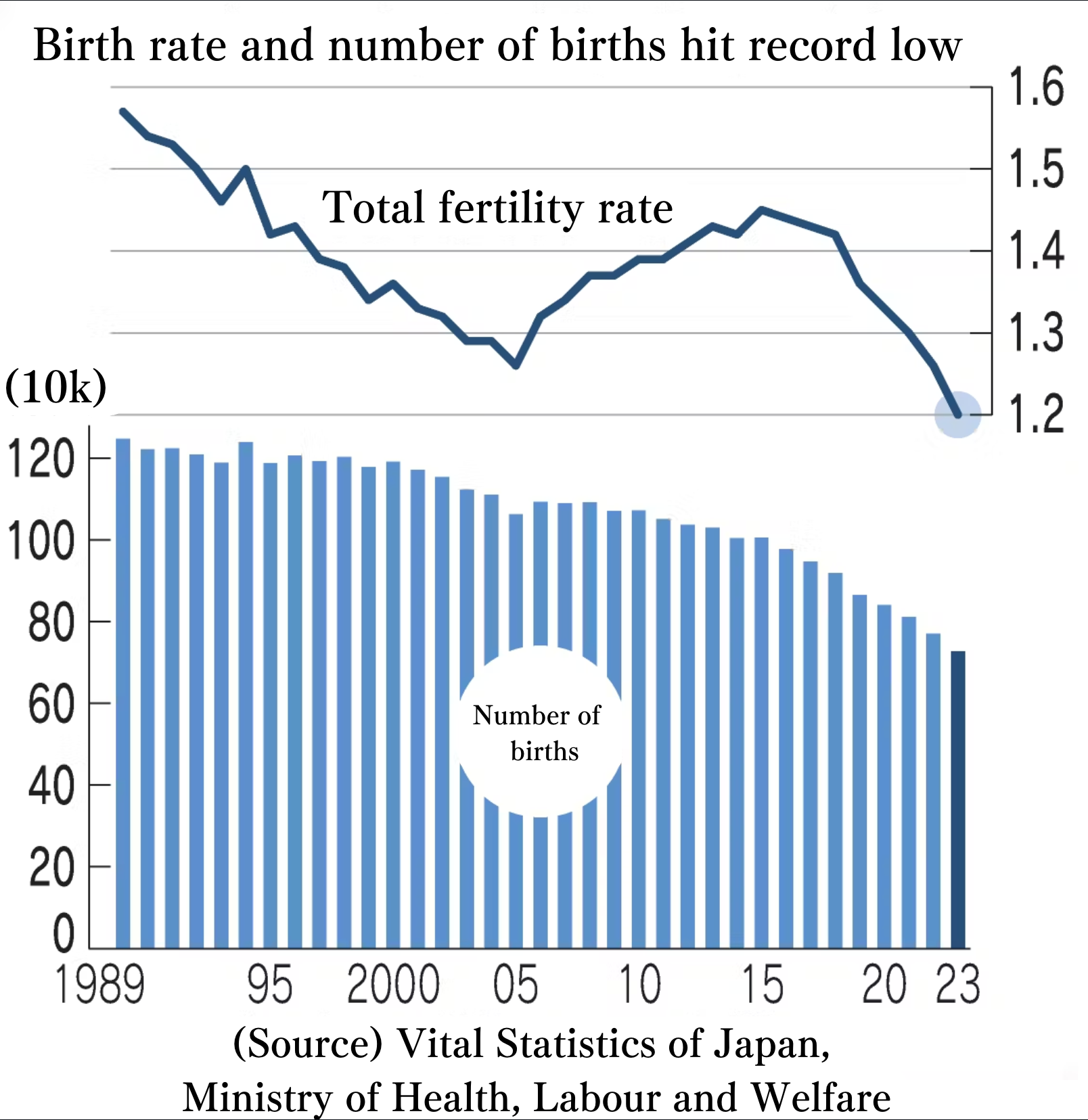
In a concerning development for Japan’s demographic future, the Ministry of Health, Labour and Welfare has reported that the country’s total fertility rate dropped to an all-time low of 1.20 children per woman in 2023. This figure, which represents the eighth consecutive year of decline, has surpassed previous record lows and falls short of government projections.
The statistics paint a stark picture of Japan’s accelerating population decline. With only 727,277 births recorded in 2023 (excluding foreign residents), a 5.6% decrease from the previous year, and marriages falling below 500,000 for the first time since World War II, the country is grappling with a rapidly aging society and a shrinking workforce.
Regional disparities are evident, with Tokyo recording the lowest fertility rate at 0.99, while Okinawa maintains the highest at 1.60. Urban areas generally show lower rates, reflecting the challenges of raising children in city environments.
The causes of this demographic shift are multifaceted. Economic pressures, including the high costs of education and housing, play a significant role. Work-life balance issues make it difficult for many to consider starting a family, while changing social attitudes have led to fewer young people prioritizing marriage and children. The average age of first-time mothers has now reached 31.0 years, indicating a trend towards later marriage and childbearing.
Japan’s situation is not unique in East Asia. South Korea, Singapore, and Taiwan are experiencing similar or even more severe declines in birthrates. Even European countries known for strong family support policies, such as Finland and France, have seen recent drops in fertility rates.
The Japanese government faces significant challenges in addressing this issue. Traditional approaches, such as financial incentives for childbearing, have shown limited effectiveness. A more comprehensive strategy may be necessary, addressing work culture, gender equality, and economic security. Additionally, immigration policy, which has played a role in mitigating population decline in countries like Germany and the United States, remains a sensitive and underdeveloped area in Japan.
For investors, these demographic trends have far-reaching implications. The shrinking workforce may impact productivity and economic growth, while changing demographics will reshape consumer markets across various sectors. The social security system will face increasing pressure, and there may be long-term effects on real estate values and urban development.
As Japan navigates this demographic transition, it presents both challenges and opportunities for its economy. Investors should carefully consider how these shifts may influence different sectors and drive policy changes in the coming years. The country’s response to this crisis will be crucial in determining its economic trajectory and may offer valuable insights for other nations facing similar demographic challenges.