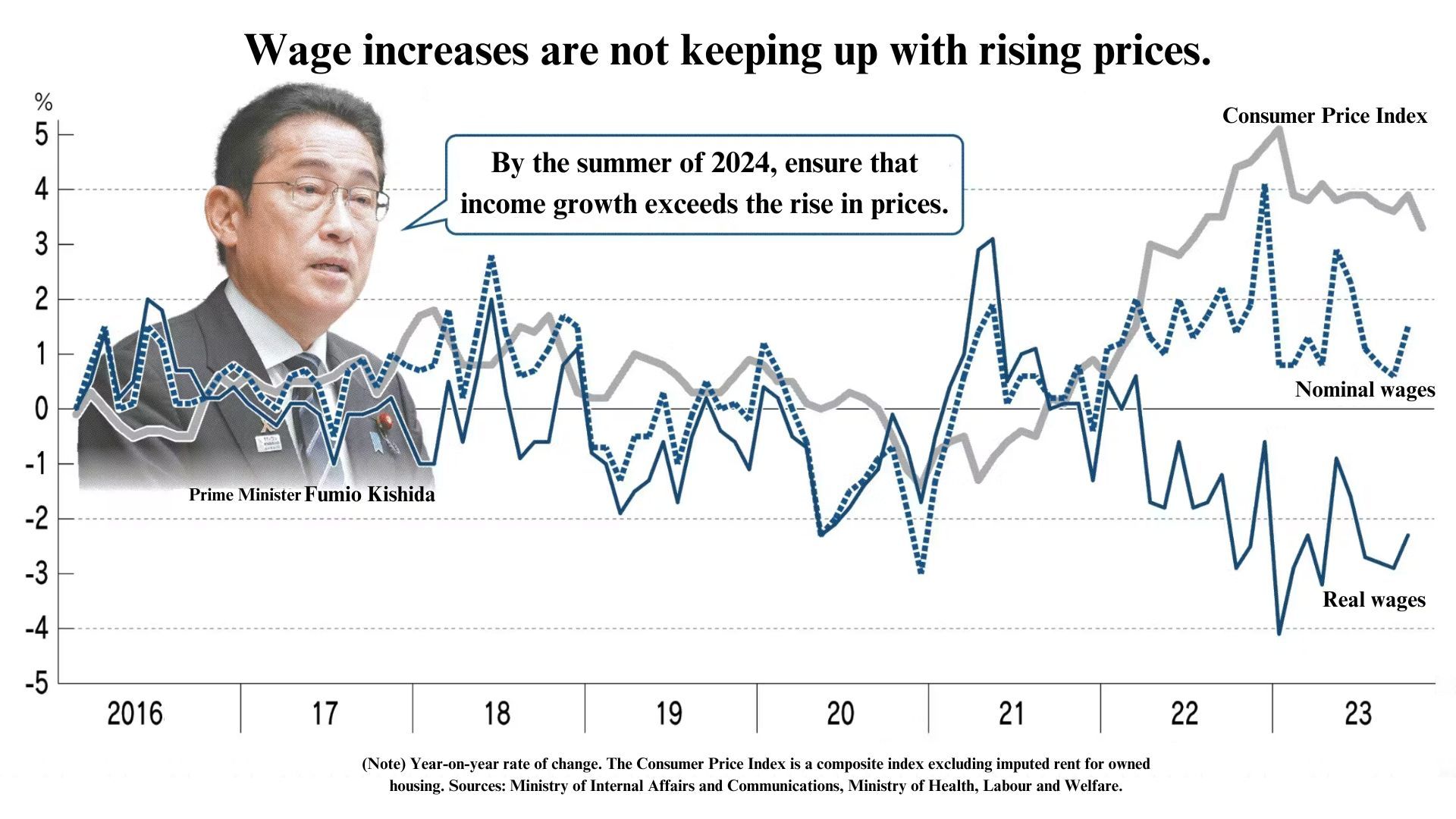
On the 22nd, the government finalized the 2024 fiscal year budget, with a general account total of 112 trillion and 717 billion yen, a decrease of 2.3 trillion yen from the previous year. Prime Minister Fumio Kishida emphasized wage increases and investment in people as key to achieving a “complete exit from deflation.” The budget aims to foster sustainable growth by focusing on decarbonization and stimulating domestic investment. Key policy points are summarized.
Prime Minister Fumio Kishida aims to achieve “wage increases that exceed rising prices” by the summer of 2024. In addition to specifying the expansion of tax systems that encourage wage increases in the fiscal 2024 tax reform outline of the ruling party, the budget also secures funding for wage increases across a wide range of industries, including corporations, healthcare, and education.
Approximately 200 billion yen is allocated for “investment in people”. This includes subsidies to companies to improve employee treatment. The budget also expands support for reskilling (relearning) to encourage labor movement into more productive sectors.
The budget for the “Career Up Subsidy,” which encourages companies to regularize non-regular workers, is increased to 110.6 billion yen. It provides up to 800,000 yen per employee for companies converting contract workers into regular employees.
The government also demands employment across a wide range of generations. Companies accepting inexperienced older workers into sectors like decarbonization can receive up to 3.6 million yen. A total of 14.3 billion yen is allocated for the “Specific Jobseeker Employment Development Subsidy” to fund this initiative.
For individual reskilling support, the related budget for “Educational Training Benefits” is increased by 10% from the previous year to 12.8 billion yen. This aims to facilitate career shifts into higher-paying jobs through skill enhancement. Qualifying individuals can receive up to 70% subsidy from the government for costs like qualification training.
Focus is also on developing digital talent. A new system allows inexperienced individuals to work in an internship-like role in IT companies, among others, for up to six months after vocational training. This aims to increase the number of people entering engineering and programming roles from other sectors, allowing them to earn a salary while acquiring new skills.
Through these measures, the government aims to increase incomes and address the issue of wage increases not keeping up with rising prices. The goal is to ensure that the growth in national income exceeds price inflation, solidifying the exit from deflation.
High prices continue at the moment. The Ministry of Internal Affairs and Communications reported that the Consumer Price Index (CPI, base year 2020=100), excluding volatile fresh food, stood at 106.4 in November, a 2.5% increase compared to the same month last year.
According to the Ministry of Health, Labour and Welfare’s Monthly Labour Statistics Survey (for businesses with 5 or more employees) released in October, real wages per person, adjusted for prices, decreased by 2.3% compared to the same month the previous year, marking a 19-month continuous decline.