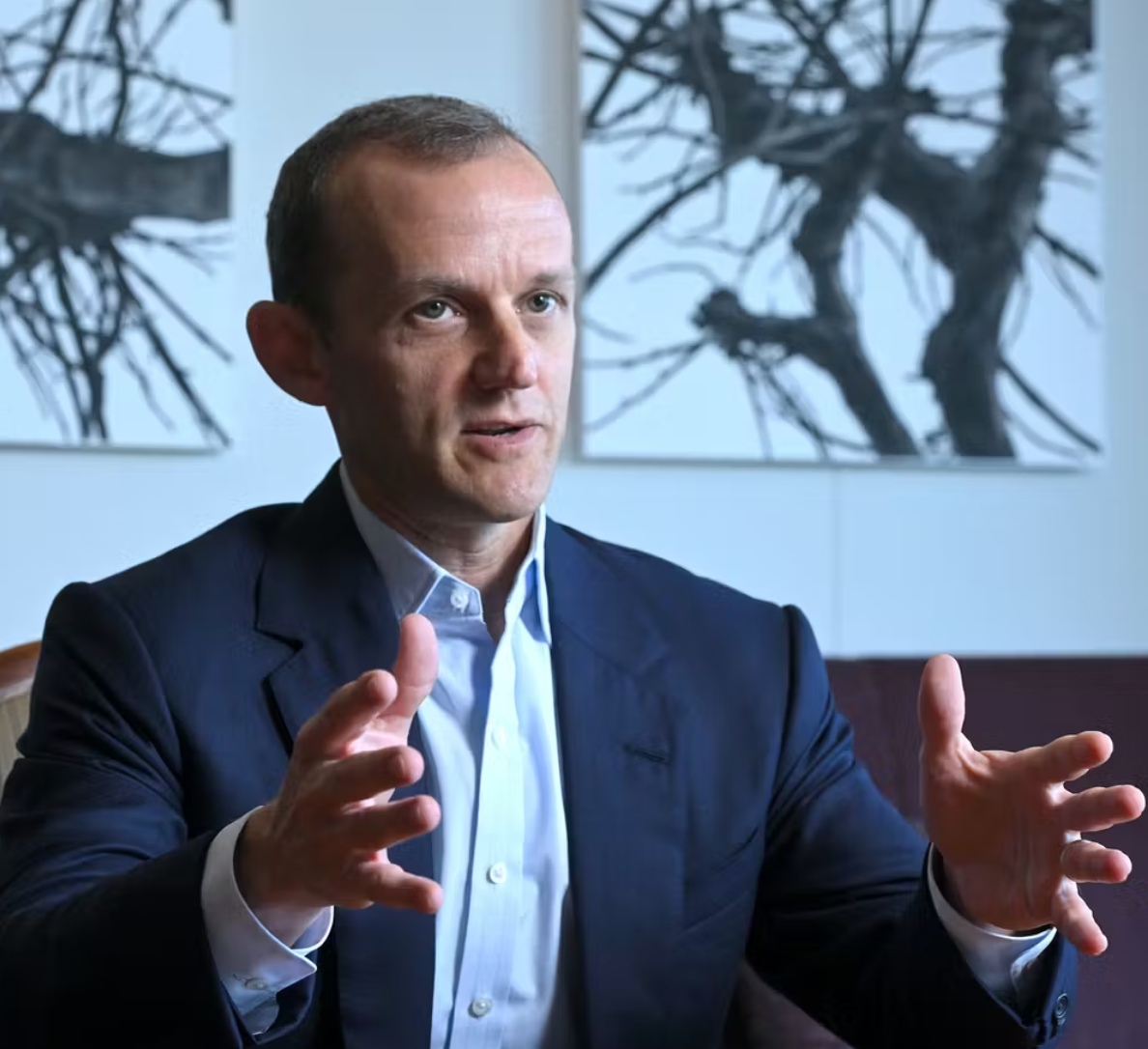
Nate Taylor, Co-Head of Private Equity at KKR
In a dialogue with the Nikkei, Nate Taylor, Co-Head of Private Equity at the American investment behemoth KKR, prognosticated that “Japan is set to become the largest investment destination in Asia going forward.” He observed that Japan’s current economic climate shares many parallels with the United States of the 1970s to 80s—a time when PE investment flourished—and expressed anticipation for expanding investment prospects.
— What is your investment policy in Japan?
“Since we inaugurated our Tokyo office in 2006, we’ve injected roughly $18 billion, inclusive of acquisitions of domestic operators with our own capital. The investment climate is burgeoning, and my visits to Japan have escalated. Japan harbors potential to become Asia’s foremost investment target in the future.”
— Why are there more investment opportunities in Japan now?
“The uptick is attributable to major corporations offloading non-core businesses and subsidiaries, with PE funds providing a receptacle. A significant factor is the increase in Japanese executives prioritizing capital efficiency and governance.”
“There are echoes of the American market of the 1970s and 80s in contemporary Japan. The U.S. then was a conglomerate-rich environment. As the stock market intensified its focus on governance, executives recognized the advantages of divesting non-core businesses, augmenting opportunities for PE funds.”
— The government is encouraging foreign asset management firms to enter by establishing special zones. Could this increase competition for KKR?
“We’ve been entrenched in Japan for nearly two decades and have established a notable track record and brand recognition. The competition in the U.S., where we’ve been active for about 50 years, is far more severe. On the contrary, an increase in the divestiture of non-core businesses in Japan would only expand our investment opportunities.”
— Globally, M&A activity has been subdued due to rising interest rates. What’s the outlook?
“The high interest rates have made fundraising for acquisitions challenging. However, entering the latter half of 2023, there’s a trend towards recovery. The funding climate is improving, and it’s becoming easier to align the seller’s price perspective with that of the buyers.”
— With Japan potentially entering an inflationary phase and rising interest rates, could this impact investment activities?
“The current inflation in Japan is at a healthy level. While the cost of capital might increase, we have consistently grown companies and enhanced their value without relying on low-interest rates.”
— With concerns over an economic downturn and heightened geopolitical risks in China, might you become more cautious with new investments?
“China is a vast economic sphere and a pivotal market. Despite challenges with the economy and regulatory oversight, it necessitates strategizing our investments. In sectors like consumer-related industries, KKR can leverage the expertise cultivated globally.”
— There has been a noticeable number of failures among PE fund-backed companies worldwide.
“KKR currently invests in over 200 companies, amounting to about $170 billion. With such a broad portfolio, some companies will inevitably encounter issues. We take preemptive measures to forestall grave problems, ensuring a generally healthy state across our investments.”
“Looking at the PE fund industry as a whole, it is indeed feeling the effects of rising interest rates. The future will likely see a divergence in fund performance based on the knowledge to mitigate these impacts.”
(Interview conducted by Daizo Wada)